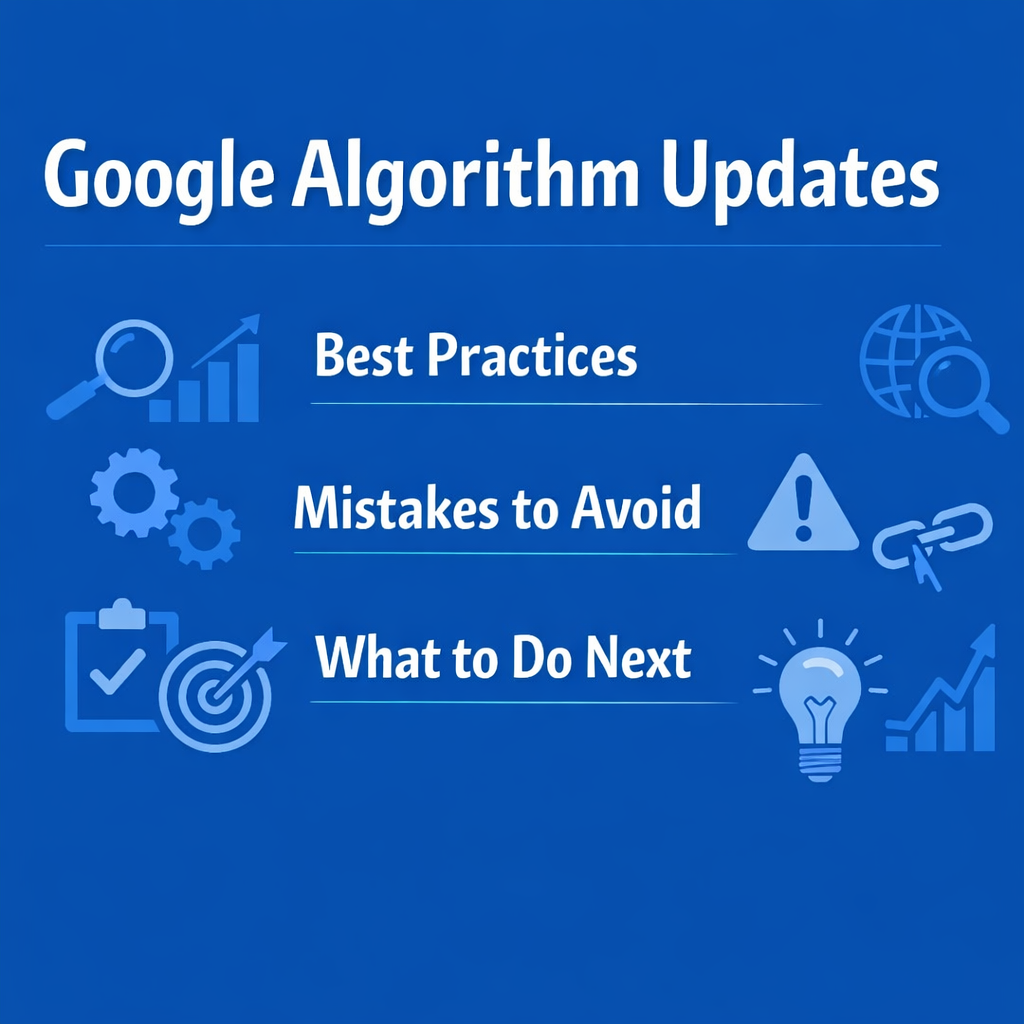
Google algorithm updates are a regular part of search engine evolution. While some updates are minor and go unnoticed, others—especially core updates—can significantly impact website rankings, traffic, and revenue.
For website owners, marketers, and businesses, the real challenge is not the update itself, but how you respond to it.
This guide explains what you should do—and what you should strictly avoid—when Google rolls out an algorithm update, following Google’s E-E-A-T (Experience, Expertise, Authoritativeness, Trustworthiness) framework.
Understanding Google Algorithm Updates
Google’s algorithm updates are designed to improve search quality by:
- Rewarding helpful, original, people-first content
- Reducing the visibility of low-quality, manipulative, or misleading pages
- Better understanding user intent, content depth, and real-world expertise
Importantly, most updates are not penalties. They are recalibrations of how Google evaluates content.
What should you do when Google releases an Algorithm Update?
1. Stay Calm and Observe Before Acting
Ranking fluctuations in the first few days are normal. Google itself advises waiting until the update fully rolls out before making major decisions.
Best practice
- Monitor traffic and rankings for 7–14 days
- Compare performance with historical data, not day-to-day noise
2. Analyze Impact at the Page Level (Not Just the Site Level)
Algorithm updates often affect specific pages, not entire websites.
Review:
- Pages with traffic loss
- Keywords that dropped significantly
- Search intent mismatches (informational vs transactional)
This page-level analysis aligns with Google’s focus on content usefulness, not domain size.
3. Evaluate Content Through the E-E-A-T Lens
Experience
- Does someone with real-world experience write the content?
- Does it include practical insights, examples, or first-hand observations?
Expertise
- Is the information accurate, detailed, and technically sound?
- Does it go beyond surface-level explanations?
Authoritativeness
- Is the author or brand recognized in the niche?
- Are there credible references or supporting data?
Trustworthiness
- Is the content transparent, updated, and honest?
- Are contact details, author bios, and policies clearly available?
If content fails on any of these dimensions, it likely needs improvement.
4. Improve Content—Don’t Just Add More Words
Google does not reward length for the sake of length. It’s rewards clarity, completeness, and usefulness.
- Updating outdated sections
- Adding expert insights or real examples
- Improving structure (headings, FAQs, summaries)
- Removing fluff and redundant paragraphs
Quality refinement consistently outperforms mass content expansion.
5. Strengthen Technical SEO and User Experience
- Page speed and Core Web Vitals
- Mobile usability
- Clean navigation and internal linking
- Secure HTTPS setup
A technically sound site reinforces trust and reliability, both of which are critical under E-E-A-T.
Read: Unlocking the Power of Dedicated Hosting: 9 Key Features
What you should NOT do during a Google Algorithm Update?
1. Do Not Panic and Make Drastic Changes
Deleting large sections of content, changing site structure overnight, or switching SEO strategies abruptly often causes more harm than good.
2. Do Not Chase “Quick Fix” SEO Tactics
- Keyword stuffing
- AI-generated content without human review
- Buying low-quality backlinks
- Copying competitors blindly
3. Do Not Assume You Are Penalized
A ranking drop does not mean your site is penalized.
- Other pages improved
- Search intent shifted
- Google re-weighted ranking signals
4. Do Not Ignore User Intent Changes
Sometimes rankings drop because search intent has evolved, not because your content is bad.
5. How Long Does Recovery Take After an Algorithm Update?
- Minor improvements: weeks
- Major content upgrades: one or two core updates
- Authority rebuilding: several months
Final Thoughts: Align with Users, Not Just Algorithms
Create content for people, supported by real experience and expertise.
- Authentic value
- Transparent practices
- Technical reliability
- Long-term trust
Read: Unlocking the Power of Dedicated Hosting: 9 Key Features
Frequently Asked Questions (FAQs)
1. What is a Google algorithm update?
A Google algorithm update is a change to how Google evaluates, ranks, and displays web pages in search results. These updates are designed to improve search quality by prioritizing helpful, accurate, and trustworthy content while reducing low-quality or manipulative pages.
2. How often does Google release algorithm updates?
Google releases thousands of small updates each year and several major core updates. While minor updates may go unnoticed, core updates can significantly impact rankings across many industries.
3. Should I make changes immediately after a Google algorithm update?
No. It is recommended to wait until the update fully rolls out before making major changes. Early fluctuations are normal. Focus first on analysis rather than immediate action.
4. Does a ranking drop mean my website is penalized?
Not necessarily. Most ranking drops during updates are due to changes in how Google evaluates relevance, quality, or search intent—not penalties. Manual penalties are rare and communicated via Google Search Console.
5. How do I check if my site was affected by an algorithm update?
You can:
- Monitor organic traffic in Google Analytics
- Track keyword movements using SEO tools
- Compare performance before and after the update rollout dates
Page-level analysis usually provides better insights than site-wide assumptions.
6. What is E-E-A-T, and why is it important?
E-E-A-T stands for Experience, Expertise, Authoritativeness, and Trustworthiness. Google uses these signals to evaluate content quality, especially for topics that impact money, health, or decision-making. However, strong E-E-A-T improves long-term ranking stability.
7. Can improving content help recover from an algorithm update?
Yes. Updating content to be more accurate, experience-driven, and user-focused is the most effective recovery strategy. Removing outdated information and improving clarity often leads to better performance in future updates.
8. Is AI-generated content affected by Google algorithm updates?
AI-generated content is not automatically penalized. However, content that lacks originality, real experience, or factual accuracy may perform poorly. Google prioritizes helpful, people-first content, regardless of how it is created.
9. How long does it take to recover after an algorithm update?
Recovery timelines vary:
- Minor improvements: a few weeks
- Major content changes: one or two core updates
- Authority rebuilding: several months
Consistent quality improvements are essential for sustainable recovery.
10. Should I build backlinks after an algorithm update?
Backlinks should be earned naturally through high-quality content and brand credibility. Avoid aggressive or low-quality link-building, as it can negatively affect trust and long-term SEO performance.
11. Do technical SEO issues affect algorithm updates?
Yes. Poor site speed, mobile usability issues, or broken pages can amplify ranking losses. A technically stable website supports trust, user experience, and overall search performance.
12. What is the safest long-term strategy against algorithm updates?
The safest strategy is to focus on user intent, publish experience-based, expert content, maintain transparent policies and author information, and ensure strong technical performance. Websites built on trust and usefulness tend to remain stable across updates.

Leave a Reply
You must be logged in to post a comment.